
AI for GTM Needs Better Data
Why Warm Data is the Missing Piece for Revenue Architects


The Problem with AI in GTM: Data Without Context
AI is often heralded as the key to personalizing engagement, optimizing GTM strategies, and driving revenue growth. But here’s the catch: AI is only as good as the data and processes revenue architects design for it. When we train it on bad or partial data and rigid processes, it’s like teaching a self-driving car how to navigate using only stop signs. It technically works—until you hit a roundabout.
Most companies assume that more data = better intelligence. The reality? Feeding AI more structured data—CRM entries, conversion rates, email open rates—only amplifies its blind spots. It makes AI faster, but not necessarily smarter.
That’s because structured data can tell us what happened, but it rarely explains why it happened. AI might notice that churn increased by 12%, but it won’t know that it’s because a key decision-maker left, a competitor undercut pricing, or a shift in the buyer’s internal politics derailed the deal.
As Revenue Architects, our job isn’t just to use AI—it’s to build systems where AI actually makes us better at what we do. That starts with deciding what kind of data we include in our systems—choosing the right mix of structured and warm data to ensure AI is working with intelligence, not just information. How do we design revenue systems that give AI the right intelligence to drive both efficiency AND impact?
This is where warm data comes in.
What Is Warm Data (And Why AI Needs It)?
Coined by Nora Bateson, warm data refers to contextual, relational insights that help us understand the why behind human decisions. Unlike structured data, which captures isolated variables, warm data reveals interdependencies—the invisible factors that shape how decisions get made.
Let’s break it down:
🚦 Structured Data: Tracks behaviors, actions, and transactions. It tells us what happened.
🔥 Warm Data: Captures context, relationships, and interdependencies. It tells us why it happened.
AI can analyze the timing of purchase decisions, but warm data can tell us how internal politics influence buying cycles. AI can score leads based on demographic fit, but warm data can tell us which leads have strong advocates internally and which will struggle to get buy-in.
For revenue architects, this presents a key design challenge: how do we build systems that integrate both structured and warm data to enhance decision-making?
Designing AI-Powered Revenue Systems: The Balance of Structured and Warm Data
Revenue architects need to integrate structured and warm data into their GTM design to create systems that don’t just automate, but also adapt and build relationships. Here’s how different GTM areas require both types of data:
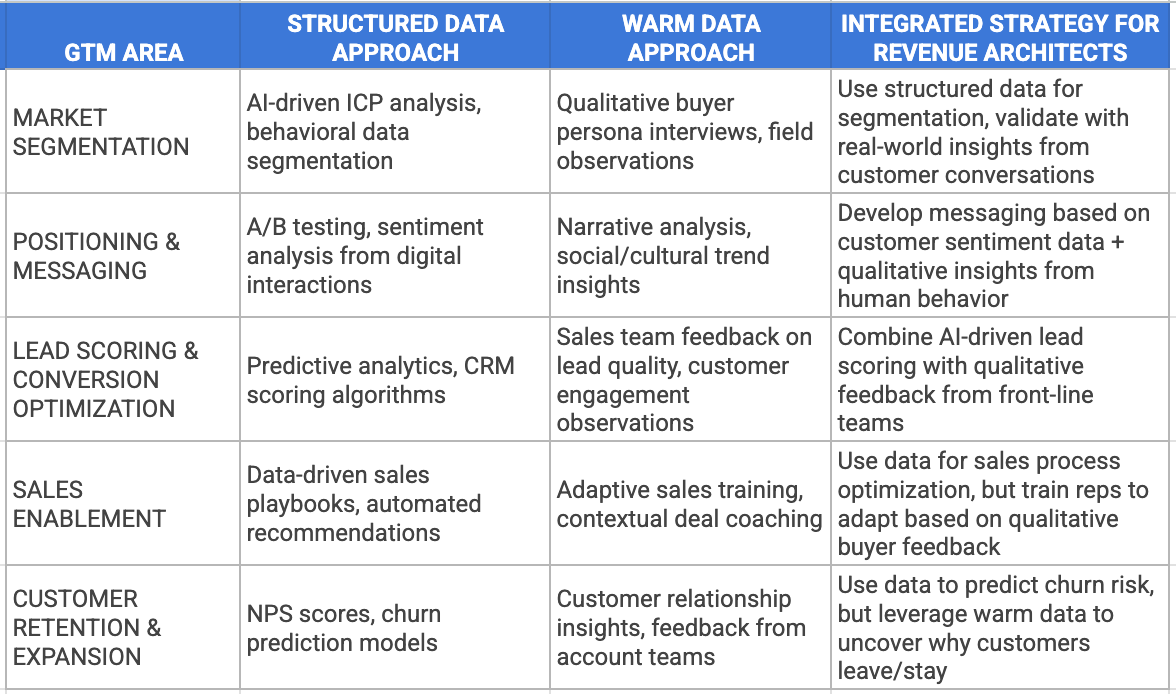
For a revenue architect, this table serves as a prompt for designing AI-driven GTM systems that incorporate both structured and warm data. The goal is not just to process information, but to architect systems that turn data into relational intelligence.
The Illusion of Intelligence: When AI Gets It Wrong
AI’s potential isn’t in doing more, faster—it’s in doing better, smarter. But when we train AI on transactional data alone it mistakes activity for intelligence and optimizes for the wrong outcomes:
✅ AI sees that higher discounting = higher deal closure rates. ❌ AI doesn’t understand that urgency and fiscal cycles actually drove the decision—not the discount itself.
✅ AI flags a sequence of outbound calls as the reason for pipeline growth. ❌ AI doesn’t recognize that the real accelerator was a well-placed executive introduction.
✅ AI determines that longer meetings lead to better close rates. ❌ AI doesn’t realize that correlation isn’t causation—the meetings were longer because the buyer was already committed, not because of the extra talk time.
✅ AI optimizes content based on open rates. ❌ AI doesn’t consider that the best content isn’t the one that gets opened the most—but the one that starts real conversations.
In other words, AI scales patterns, but it doesn't ask why they work.
What This Means for the Revenue Architect
For revenue architects, the takeaway is clear: AI is only as good as the systems we build for it and the data we feed it.
Structured data is essential for scale, but without warm data, AI can’t interpret relationships or adapt to real-world complexities.
AI should be an intelligence amplifier, not an efficiency optimizer. The best AI-powered GTM systems aren’t designed to replace human judgment—they’re designed to enhance it. AI should be the co-pilot, not the autopilot.
Process and data must work together. It’s not enough to feed AI better data—we need to build GTM architectures that let AI recognize context, trust signals, and interdependencies.
If we don’t design systems that balance structured and warm data, we risk AI becoming nothing more than a faster version of the same old GTM mistakes.
Keeping the Lights On
After all, none of us are designing AI to replace relationships. We’re designing it to enhance them.
The best revenue systems won’t be the ones that just scale faster. They’ll be the ones that know when to listen, when to adapt, and when to build trust.
AI can send a thousand follow-ups, but it can’t read the raised eyebrow of a CFO deciding whether to greenlight a deal. And that—not just automation—is what keeps the lights on. And trust—not just automation—is what keeps the lights on.
Interested in Revenue Architecture?
Here are a few recommendations:
Get certified by taking Winning by Design’s course
DM me to schedule a call to explore how Winning by Design can help you re your GTM organization.
or…